We've been to the moon, but we still do pipe takeoffs by hand.
After speaking with 50+ industrial pipe estimators across North America, we learned why manual takeoff from isometric drawings still eats up days of estimator time, slows down bids, and leaves work on the table.
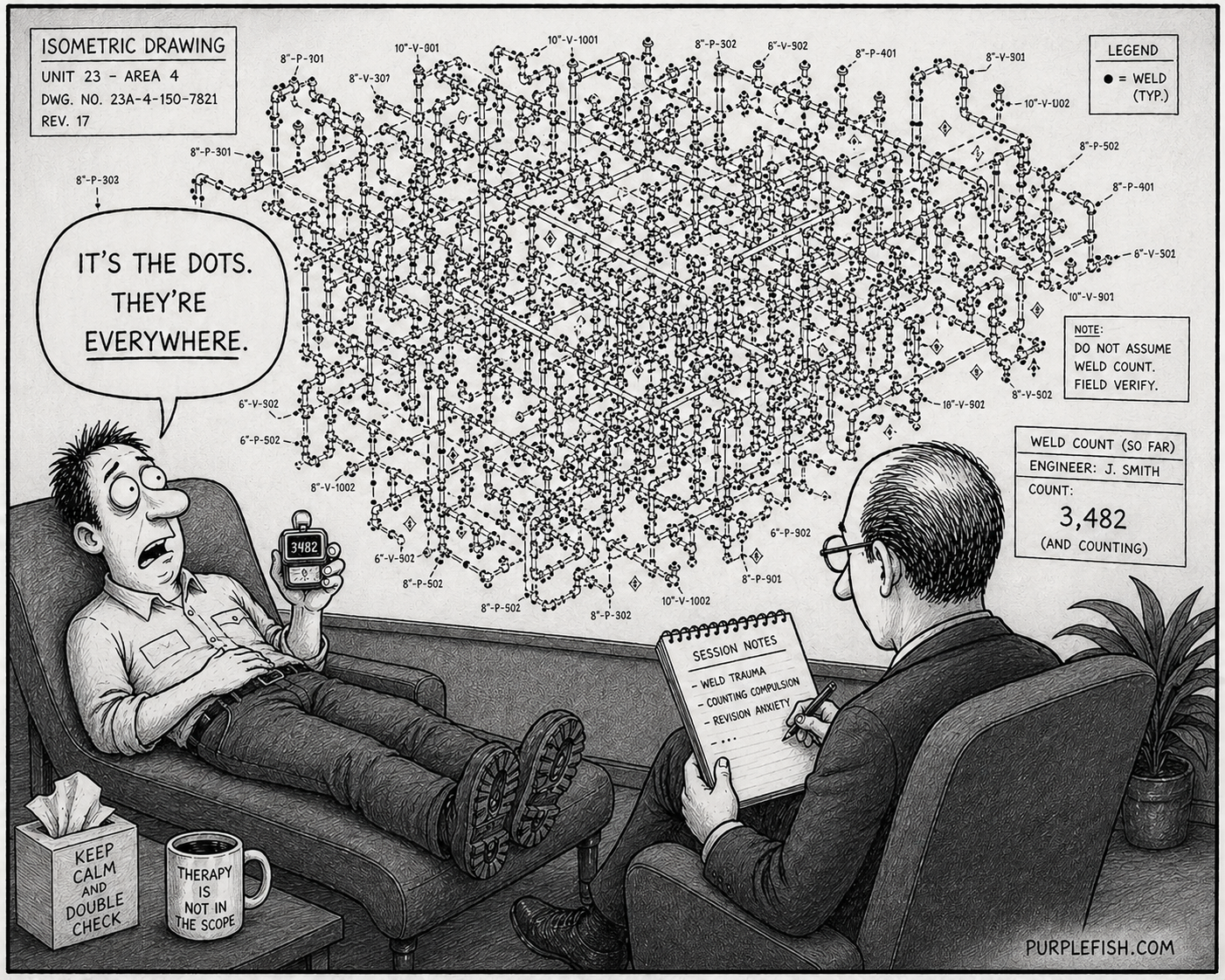
Why we started building for industrial pipe takeoff
The grind of manual takeoff from an isometric drawing can be summed up in the following sentence:
“Grab a can of Zyn, grab a Diet Coke, maybe grab somebody's Adderall, because you're gonna need it or you're not gonna make it.”
These are an estimating director's words from a large pipe fabricator out in Texas. Clearly, for industrial pipe estimators, manual takeoff from isometrics is one fat headache. On our end, we realized quickly that you can't hire your way out of it.
Purplefish was initially building tools for industrial staffing firms. We helped them hire great talent: welders, estimators, and everyone in between. It was clear from the start that these industrial contractors are facing a real talent shortage, especially in estimation. Most of the folks doing this work have been at it for decades, but there aren't enough young people coming in behind them. Another director of estimating at an industrial contractor put the whole exodus in plain language:
“As a whole, a lot of our experienced estimators came from the field. They did it. They knew what was going on. They have a 100% understanding of what it takes in order to do a project. That group is now leaving, retiring. And there are just less and less young people going into the trades, so it's hard to get somebody to come up with that kind of experience. It's hard to backfill that.”
There's a real battle over the few people who know how to weld, estimate, and manage industrial construction projects. But the more contractors and shop owners we spoke to, the more we started to see the problem differently. The issue wasn't only that contractors needed more experienced people. It was that the people they already had were stuck doing too much manual, repetitive work with tools that weren't built for them. Residential and commercial contractors have no shortage of software. Industrial contractors, especially pipe fabricators, have been far more underserved with good technology.
Over the past few weeks, we spoke to over 50 different industry experts. We spoke to folks across the Gulf Coast all the way up to Alberta. Small shops, mid-size contractors, and some of the biggest names in industrial construction.
The one common theme? Estimation is a major bottleneck that affects not just the top and bottom lines, but morale as well. For industrial pipe estimators, manual takeoff from ISOs (isometrics) is wildly time-consuming and repetitive, and often drives young estimators to seek different roles after a year or two of pain.
To help us learn and appreciate the craft, everyone on our team has done multiple, manual, material takeoffs… calling it a “big headache” is not a metaphor, in fact, many of our team find themselves literally dreaming of ISOs.
What an isometric drawing actually is
A single-line representation of a piping system that shows the 3D routing of pipe, fittings, valves, and supports on a 2D page using isometric projection. Each ISO typically covers one or more pipe spools or lines, and often (but not always) includes a bill of materials listing the components on the drawing.
Estimating industrial piping projects is a difficult, nuanced task with high consequences. For that reason, “a strong estimator is worth their weight in gold.”
In the world of industrial piping, an estimator receives a packet of isometric drawings that informs the project and, ultimately, the bid. An estimator works through each isometric line by line, pulling every row of the bill of materials, or “BOM” (pipe, fittings, valves, flanges, gaskets, bolts), and counting every weld on the page, then rolling it up into a material takeoff (MTO) and a labor takeoff (LTO). Takeoffs need to be accurate: even the smallest oversight can be very, very expensive.
One estimator at a mechanical contractor in Alberta explained, “To miss just even an 8-inch ball valve could cost you $5,000.”
Recently, we were walking the shop floor in Baton Rouge and walked past a massive valve that came up to our CTO, Martin's, chest. “Wow, that must be, what, $100,000?” he asked. Our host chuckled, “Not even close!”
The list of components in a bid packet, often shown on an individual drawing, including pipe, fittings, flanges, valves, gaskets, and bolts with their sizes, schedules, and quantities. Multiple BOMs roll up into a single project-level MTO.
The rolled-up list of every material required to build a piping project, aggregated across all the drawings in the package. Estimators use the MTO to price materials, request vendor quotes, and plan procurement.
To make matters more difficult, the ISOs that estimators work from are rarely complete or final. We often hear that engineering keeps evolving even as bids go out the door. In situations like this, industry experience is vital to help you catch any errors or missing pieces of the drawing.
On that same point, an estimator at a midstream contractor in Houston shared the following:
“The current trend I see is engineering more and more every single day. It's like they want to engineer as we go, as opposed to ‘let's figure out what we're building and then go build it.’ So bid packages are getting weaker and weaker.”
The problem: why manual pipe takeoff takes so long
The greatest challenge of manual takeoff, and what ultimately inspired us to build in this space, is the painful amount of time it takes.
An estimating VP at an industrial contractor in South Carolina put it like this:
“Just doing it manually… it is time intensive. Occasionally we'll get packages that may have 1,200 or 2,500 pages to it. Not all the time, but some of the bigger jobs do. And generally when you get that, you're dedicating one or two guys to it for a couple of weeks.”
We spoke to one senior estimating manager from Louisiana who told us that the biggest takeoff she's done was over six thousand pages. When asked how long it took her, she told us that she had to bring in three to four people from her team. Over three weeks, they hammered it out, drawing by drawing, heads down until the very last page. All of that hard work…and they lost the bid.
We've met multiple people who have received bid requests from an Elon Musk company. It usually goes like this: here is a several hundred page bid packet and all bids are due in 24-48 hours. For context, it generally takes 4-5 days on average to get pricing on parts back from your suppliers.
The math doesn't math.
Another estimating manager at an industrial contractor elaborately walked us through the daily grind of managing takeoffs, especially when revisions are needed:
“Our estimators are backlogged constantly. They've got about two weeks per bid, but it's never a final. The client comes back with a CoQ, a clarification of quote, with a laundry list of items. The estimator has to revisit all of it. He can whip through 80%, but there's always this 20%. And then revised drawings come in. You just never really know.”
We have many more quotes like the ones shared above from estimators across all of North America. All share the pain of manually taking off an ISO. All see manual takeoff as busy work that pulls them from more important, strategic work. All want to see something done about it.
The hidden cost: bids left on the table
It's one thing to see the time it takes to grind through a fat packet of ISOs. It's another to register what that time can cost in revenue.
For these industrial contractors, every project starts with the bid. Before anything hits the shop floor or the field, an estimator has to price it, and a bid has to be won. Average win rates for industrial pipe projects range from 10%-30%. Logically, an industrial contractor's bid output is capped by its estimating capacity.
Generally speaking, the more you bid, the more you win. We've also heard bidding is used as a future lead generation tool, where contractors will bid on projects they don't plan to, or even want to win, just to keep their name top of mind for future opportunities.
Like a clump of hair, manual takeoffs clog that drain. It's not uncommon for an industrial contractor to pass up on bids simply because estimators are bogged down on other projects.
When asked if they ever miss out on opportunities, a VP at a fabrication shop we spoke to answered:
“Always. Yeah, we probably receive over a hundred opportunities a month. And we can only get to, you know, 60 to 75 of them. A lot of those we're choosing not to… But yeah, there's definitely some attrition based on capacity.”
Another fabrication supervisor we spoke to answered the same question similarly:
“Yeah, that's for sure. It's a problem sometimes, right… Is it worth our time? Do we have the time for it right now? We're too busy, right? Obviously if there's a good job, we're gonna pull out all the stops to do it, but there's definitely jobs left on the table.”
Some shops bid 100% of the projects they want to, but that requires pulling in senior folks from other work which has real opportunity cost.
Either way, it was clear to us that money is getting left on the table because of the inefficient takeoff process.
Why generic AI tools miss on isometrics
Our conversations brought us to an obvious question: if this is so widespread and, on the surface, automatable, why hasn't anyone solved it yet?
Our confusion was matched by a director of estimating out in Texas who captured the absurdity of this archaic process:
“You'll have a client send you 5,000 ISOs, and they're like, ‘hey, take these off.’ It's a very manual process. I used to joke about it. Like, we've been to the moon, but we can't figure out how to do this. We have this whole room with people, 20 people doing nothing but hand sketches and drawing things on it or writing things down on a piece of paper and then putting it into Excel. It's like, this just doesn't seem very efficient.”
When we asked why nobody had solved this, the answer we often heard was: there are takeoff tools out there for other sectors of construction and different types of drawings such as plan view, but there isn't anything specifically designed for industrial piping and isometric drawings.
With all the talk of AI making its way into every crevice of our lives, it's understandable why estimators are frustrated that it hasn't come for manual takeoff yet. An estimator at a pipe fabricator said it most directly:
“For years we've been promised that there would be tools available that would automate a lot of these tasks, and I haven't seen it come from anybody.”
Many estimators have tried taking things into their own hands and experimented with running packets through PDF OCR tools, ChatGPT or Microsoft Copilot.
But with the huge cost of inaccuracy: if it's not near perfect, it's not an option.
The fact is, those tools simply haven't been trained on isometric drawings. Unless the packet is small, neat, super clean, and perfectly legible, those systems almost always miss or inaccurately extract information.
You often spend more time reviewing and cleaning up their output than the time it would have taken to do the takeoff manually in the first place.
The main reason for this is that isometric drawings are usually, at best, non-standard, and at worst, extremely messy. BOMs can be any number of different formats, even from page to page. They can be in multiple locations, they can be upside down, they can be handwritten, they're copied and pasted from older versions and revised over and over.
The same item can be called different things by different engineers, and the same item can be called different things by the same engineer, from one page to the next.
These drawings can be overly scanned to the extent that even a human has a hard time reading them. As we established earlier, there's a growing consensus that the quality of these packets is declining over time. This only makes the estimator's job harder, as if it wasn't hard enough.
A director of estimating at an industrial services firm in Louisiana described what it looks like when you try to run a messy drawing through one of the existing AI tools:
“I loaded two ISOs exactly the same. One was a live PDF, the other was a scan. Did not recognize one-and-a-quarter inch. Did not recognize threaded. Also does not recognize reducers and olets. And then of course, on a scanned takeoff, some BOMs completely missing, some fives were turned to S's. So tags for valves and things like that. 45s instead of 40s schedule… things like that.”
Our tech team has been building with LLMs for years so this was no surprise to us. These generic tools have not been trained on the drawing types these estimators work with. If accuracy doesn't matter, the popular LLMs will get you maybe 75% of the way there out of the box. But building a tool that is consistently over 99% is a very big technical challenge. That's where we come in.
How Purplefish works
Purplefish is an AI takeoff tool for industrial piping estimators.
Upload a packet of ISOs, review the extracted BOMs side-by-side with the original drawings, roll up the full material takeoff, and export it to Excel with one click.
Today, we focus on BOM extraction and material takeoff. Next, we're expanding into labor takeoff, while keeping oversight and control in the hands of the estimator.
Our goal is simple: build the fastest, most secure and most accurate industrial takeoff tool in existence. That means handling any ISO of any kind. Building a tool that handles clean, organized PDFs with accuracy is one thing. Building one that handles the messiest, hardest-to-read isometrics with near-perfect accuracy is another. Thanks to our elite engineering team, we're averaging over 99% accuracy when extracting the BOM from isometric drawings.
We compare Purplefish's extracted BOM data against the source drawings row by row, character by character. An error is any discrepancy that would materially ($) impact the estimate: missing rows or items, extra, wrong or missing quantities, sizes, descriptions. We exclude things like capitalization differences, minor formatting variations, extra spaces, non-critical spelling issues, and immaterial columns. As of April 25th, 2026, our QA team has audited the results of over 2,500 pages across dozens of different packets. Accuracy = (rows audited − material errors) / rows audited
To complement our technical team, we've assembled an advisory board consisting of over a dozen senior estimators and pipe fabricators with decades of experience under their belt, guiding and pressure-testing our product roadmap. We're combining the expertise of world class AI engineers with the best industry knowledge and experience to create the ideal antidote to manual takeoff.
From three weeks to thirty minutes
This is where the time savings become obvious: the same packet that once took days to take off manually can now be processed and ready for review in minutes.
Without Purplefish, a manual takeoff means blocking off days or weeks at a time for a large packet. An estimator at a Texas pipe fabricator described exactly what that grind looks like from the inside:
“On average, if they're just sitting down, like, put your headphones in and just grind through it, 50 to 75 on average. If you're really good, you can get 100 on a good day. But that's a real grind, it's not sustainable, and usually accuracy becomes a problem at that speed.”
With Purplefish, that same packet gets processed in minutes. On average to date, a 500-page packet takes us about an hour before it's processed and ready for human review. Recently, we processed a packet over 2,200 pages in just over an hour. Put simply, Purplefish boils down a task that would take multiple days (and people) into a few clicks and a coffee break.
On top of that, when you consider that a team now has significantly more capacity to bid on more projects, or focus on more strategic and higher leverage work, it becomes both a time-saver and a profit generator for the company.
Thank you
Thank you to the estimators, the project managers, the shop managers, the quality control experts, and the executives we spoke to. Everyone we've connected with so far has been incredibly friendly and ruthlessly honest, which has helped us identify the problem and solution faster and more clearly.
It's exciting and humbling to be working with the folks who build the infrastructure that America runs on.
The mission is clear: build the ultimate tool for industrial estimators to enable contractors and fabricators to bid more, bid faster, and bid smarter.
Full bore ahead,
Adam, Martin & The Purplefish Team
Note: All quotes are from real conversations and have been anonymized by role and company type for privacy.